REVIEW · RIO DE JANEIRO
Rio Jewish Heritage Half-Day Tour
Book on GetYourGuide →Operated by CARIOCA TROPICAL TOUR OPERATOR · Bookable on GetYourGuide
Jewish Rio has surprising angles. I love how the tour strings together real streets with big-name Jewish sites, starting with Park Itzhak Rabin and those sweeping Botafogo beach and Sugar Loaf views. Two things really hit for me: the storytelling from guide Leonardo (he brings his own background into the larger picture), and the way you get Jewish life in Brazil through architecture, neighborhood details, and museum context. One watch-out: entrance fees are not included, so you should budget for small on-site payments like the Jewish Museum ticket and a tzedakah contribution at the Grand Synagogue.
This is a small-group half-day that moves at a comfortable pace for sightseeing without feeling like you’re rushing. Hotel pickup and drop-off, plus an air-conditioned ride, help you keep your energy for the actual visits. If you’re hoping for a long, museum-heavy day, 3 hours will feel focused rather than leisurely.
In This Review
- Key Things I’d Book It For
- First Stop: Park Itzhak Rabin and the Botafogo–Sugar Loaf View
- Downtown Context at Chaim Weitzman Square and Catete
- Jewish Museum and the Grand Temple: Where 1932 Matters
- Synagogue Shel Gmelut Hassidim and the Dom Pedro II Visit
- Copacabana Stops: Club Israelita Brasileiro and Beth El Synagogue
- Possible Synagogue Replacements Based on Request and Availability
- Price and Value: Does $99 Make Sense for 3 Hours?
- Who This Tour Fits Best (and Who Might Prefer Something Else)
- What I’d Watch For Day-Of
- Should You Book the Rio Jewish Heritage Half-Day Tour?
- FAQ
- How long is the Rio Jewish Heritage Half-Day Tour?
- What is included in the $99 price?
- Are entrance fees included?
- Which languages does the guide speak?
- Where does the tour start?
- Can synagogues change during the tour?
- Is a kosher lunch available?
- What should I wear?
- Is there a cancellation policy?
Key Things I’d Book It For
- Park Yitzhak Rabin for Botafogo beach and Sugar Loaf views before the history lesson
- Leonardo as a guide who ties Jewish stories in Rio to broader context through his own lens
- Chaim Weitzman Square and the Anne Frank-named school stop
- Jewish Museum + Grand Temple (1932) for architecture and community memory in one run
- Sephardic Synagogue Shel Gmelut Hassidim and the Dom Pedro II connection
- Copacabana Jewish landmarks plus optional synagogue swaps if you request them
First Stop: Park Itzhak Rabin and the Botafogo–Sugar Loaf View
The tour kicks off at Park Yitzhak Rabin, a smart start because it gives you a skyline moment before you get into names and dates. You’ll learn that the park was inaugurated by Lea, Itzhak Rabin’s wife, and you’ll enjoy privileged views over Botafogo beach and Sugar Loaf. It’s a great mental reset: you’re in Rio, with a wide-open view, then the guide pulls you from the scenery into the story of Jewish presence in Brazil.
I like this approach because it’s not history in the abstract. You can actually picture where you are, and that makes the later stops feel less like random pins on a map. Do take a moment with your camera here, even if you think you’ll remember later. Views like this are why Rio sells out first.
You can also read our reviews of more historical tours in Rio De Janeiro



Downtown Context at Chaim Weitzman Square and Catete
From the park, the tour heads toward Downtown and adds human scale to the topic. You stop at Chaim Weitzman Square, and you’ll also see a public school named after Anne Frank. Even if you know the Anne Frank story already, seeing how the name lives in a school here gives it a different weight. It’s one thing to read about people impacted by persecution; it’s another to see how memory becomes part of everyday city life.
Next comes Catete. Here’s where the tour becomes extra practical for understanding Rio: you learn that resident Jews formerly established a thriving furniture commerce in the neighborhood. That’s the kind of detail that helps you avoid the common mistake of thinking community history only shows up in synagogues. Markets, trades, and local business were part of the picture too.
You’ll likely feel a shift after this segment. The tour stops being just a list of Jewish sites and starts working like a map of how communities took root in ordinary Rio neighborhoods.
Jewish Museum and the Grand Temple: Where 1932 Matters
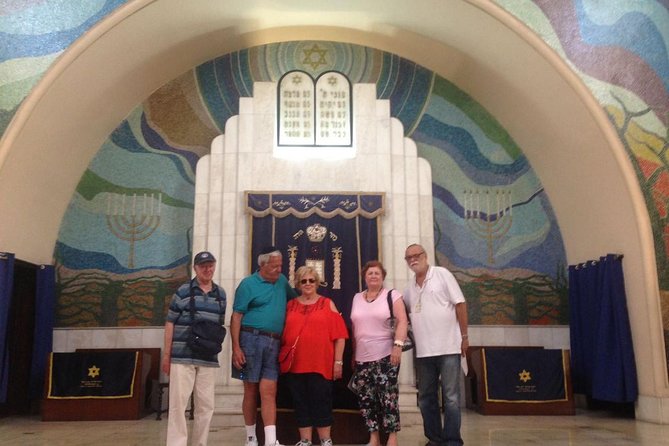
After the downtown storytelling, you head to the Jewish Museum and the Grand Temple, a beautiful building dating to 1932. This is one of those stops where you should set your expectations to match the time you have. In a half-day, you won’t become a scholar, but you will leave with a clearer sense of how Jewish life in Brazil evolved and why these institutions were built in the first place.
Two practical notes:
- The Jewish Museum has a USD 3.00 per person ticket fee (entrance fees are not included).
- The Grand Temple area involves a “Tzedakah” contribution of USD 6.00 per person (also not included).
I actually like that the tour tells you these costs plainly. Museums and religious spaces cost money to maintain, and tzedakah is part of how the community keeps sites open. It turns your visit into something you can respect properly instead of guessing.
If you’re the type who likes to understand why architecture looks the way it does, the Grand Temple stop is a good fit. The building’s age matters, and the guide’s framing helps you see it as more than a photo backdrop.
Synagogue Shel Gmelut Hassidim and the Dom Pedro II Visit
One of the tour’s most interesting religious stops is the Synagogue Shel Gmelut Hassidim, located in Botafogo. This synagogue belongs to the Sephardic Jewish-Spanish rite, so it’s not just a generic stop—it’s a specific branch of tradition with its own identity.
You’ll also learn a notable historical detail: the synagogue has received the visit of emperor Dom Pedro II. That’s a powerful Rio connection. When a synagogue is remembered in relation to a national figure, it helps you see how Jewish communities were not only present, but also visible enough to intersect with power and public life.
I recommend you come into this part with two attitudes:
1) curiosity about differences in rite and practice, and
2) respect for rules inside religious spaces.
The tour covers multiple synagogues and styles in a short time, so keep your notes simple. You don’t need to track every detail. Just anchor what you can: where it is, which rite it represents, and what the guide highlights as the meaning behind that.
Copacabana Stops: Club Israelita Brasileiro and Beth El Synagogue
Then you roll into Copacabana, where the tour adds the community-meets-city feel again. You’ll visit the Clube Israelita Brasileiro and the Beth El Synagogue. This is a good change of pace from the museum and grand building vibe. Clubs and community institutions often show a broader side of Jewish life, not only worship but also social structure and collective identity.
Copacabana also works well for perspective. After seeing Jewish sites tied to major public history and older institutions, you get to see how community life continues in a neighborhood that’s constantly moving and changing.
And here’s where you should pay attention to flexibility.
You can also read our reviews of more tours and experiences in Rio De Janeiro






Possible Synagogue Replacements Based on Request and Availability
The tour notes that the synagogues Beth Yacov (Eastern-European Ashkenazi rite) in Copacabana and Beit Lubavitch (Orthodox Chasidic rite) in Leblon may replace other synagogues, depending on client request and/or availability. That means your exact lineup might shift.
If there’s a particular tradition you want to see—Sephardic, Ashkenazi, or Orthodox Chasidic—tell your booking contact ahead of time. It’s a small effort that can make your visit more meaningful.
Price and Value: Does $99 Make Sense for 3 Hours?
At $99 per person for a 3-hour small-group tour, you’re paying for a focused mix of transportation, a professional guide, and multiple major sites. The included items are clear: hotel pickup and drop-off, transport by air-conditioned minivan or car, and a guide in Spanish or English.
So is it good value? For me, the answer depends on how you like to travel:
- If you like structured sightseeing where someone else handles the order and context, yes, this is a fair deal.
- If you prefer to wander on your own and spend more time inside museums, a half-day may feel a bit tight.
Don’t forget the add-on costs:
- Jewish Museum: USD 3.00 per person
- Grand Synagogue contribution: USD 6.00 per person
- Other entrance fees may also apply (entrance fees are not included overall)
Still, the overall cost remains reasonable considering you’re visiting multiple Jewish landmarks across different parts of Rio, with both museum and synagogue time. And because it’s small-group, the guide can answer questions without the tour feeling like a scripted bus stop sprint.
Who This Tour Fits Best (and Who Might Prefer Something Else)
I think this tour is especially good for you if:
- you want a concentrated way to learn Jewish heritage in Rio without committing to a full day,
- you enjoy a guide who explains how the story shows up in real places (squares, schools, neighborhoods),
- you care about how different Jewish rites and communities exist side by side in one city.
It’s also a strong pick for first-time visitors who want smart orientation plus a cultural theme. The itinerary touches Botafogo, Downtown, Catete, and Copacabana, which is a useful geographic sampler in only 3 hours.
If you want a long, slow pace inside one museum, or you’re traveling strictly on a tight budget with no on-site payments, you might feel the entrance fees add up. But the tour does give you the key costs upfront.
What I’d Watch For Day-Of
A few practical pointers to make the day smoother:
- Dress appropriately for synagogue visits. This is stated as a requirement, and it matters.
- Wear comfortable shoes. Even with driving between stops, you’ll be on your feet at several locations.
- Bring some patience for transitions. Religious sites and museums have their own timing and flow.
- Choose your language preference early if you can: Spanish or English.
Also, the tour asks for a minimum of 2 people per booking. That’s common, but it’s worth noting if you’re booking last minute as a solo traveler.
Should You Book the Rio Jewish Heritage Half-Day Tour?
Yes, I’d book it if you want a well-paced, theme-driven look at Jewish life in Rio with a guide who makes the connections feel human. The combination of Park Itzhak Rabin’s views, neighborhood context like Catete, and the mix of museum plus major synagogues gives you more than a photo tour. And if you specifically want a guide with strong storytelling, Leonardo is a standout name tied to this experience.
If you’re unsure, here’s the quick decision test: if you’d rather spend 3 hours learning with a plan than 3 hours wandering and hoping you find the right context, this is the smarter call.
FAQ
How long is the Rio Jewish Heritage Half-Day Tour?
The tour duration is 3 hours.
What is included in the $99 price?
You get a professional guide, hotel pick-up and drop-off, a small-group tour, and transport by air-conditioned minivan or car.
Are entrance fees included?
No. The Jewish Museum ticket is USD 3.00 per person, and the Grand Synagogue requires a “Tzedakah” contribution of USD 6.00 per person. Other entrance fees may also apply.
Which languages does the guide speak?
The live guide speaks Spanish and English.
Where does the tour start?
It begins with a visit to Park Itzhak Rabin.
Can synagogues change during the tour?
Yes. Beth Yacov (Ashkenazi rite) and Beit Lubavitch (Orthodox Chasidic rite) may replace other synagogues according to client request and/or availability.
Is a kosher lunch available?
Kosher lunch is available upon previous request.
What should I wear?
Dress appropriately for the synagogue visits.
Is there a cancellation policy?
There is free cancellation up to 24 hours in advance for a full refund.