REVIEW · RIO DE JANEIRO
Tijuca Forest w/ Chinese View,cascatinha Taunay,horto waterfall and parque laje
Book on Viator →Operated by Trip In Rio · Bookable on Viator
Rio’s wild side is only minutes away. This guided half-day threads together Tijuca National Park nature with big-picture history at Vista Chinesa and the Cascatinha Taunay waterfall area. You get a mix of paved viewpoints and real forest paths, plus stops tied to Rio’s Chinese tea legacy.
What I like most is how the walk-and-lookout plan actually works: the Vista Chinesa route is easy to start (it’s fully paved), but you still earn the top views. I also love that the tour doesn’t treat the waterfalls and lookouts like random photo stops; it connects what you’re seeing to the stories behind the Chinese influence and the Taunay family.
One thing to plan around: this experience needs good weather, and at least one leg includes a demanding, steep climb to the peak. If rain fogs the viewpoints, your best moments can shrink.
In This Review
- Key takeaways
- Tijuca Forest, but with viewpoints that make sense
- Vista Chinesa: the easy-start climb to a big payoff view
- Emperor’s Table: Chinese labor stories tied to a royal resting spot
- Cascatinha Taunay: waterfall beauty plus a Roman-arch bridge
- Parque Lage: Atlantic Forest walks near Jardim Botânico
- How the 4-hour route stays manageable
- Price and value: what $88.21 buys in Rio
- The small details that make a guide matter
- Weather and comfort: your best decision isn’t about the tour
- Should you book this Tijuca-and-waterfall tour?
- FAQ
- How long is the tour?
- How much does it cost per person?
- What’s included in the tour price?
- Is the group size limited?
- Which stops are part of the experience?
- Are any admission tickets required for the stops?
- Are snacks or bottled water provided?
- What happens if the weather is bad?
- What is the cancellation policy?
Key takeaways
- Vista Chinesa’s paved climb: easy to access trail, but a steep finish to the lookout
- Chinese tea history, up close: Emperor’s Table ties Rio’s lookout pavilions to Chinese labor and tea planting
- Cascatinha Taunay’s waterfall setting: plus a Roman-arch stone bridge built in the 1800s
- Wildlife odds in the Atlantic Forest: monkeys can be spotted overhead, and toucans are possible
- Parque Lage forest time: 52 hectares inside Tijuca, near Jardim Botânico and Cristo Redentor
- Small group feel: up to 14 travelers, with transport in a car/jeep setup depending on group size
Tijuca Forest, but with viewpoints that make sense
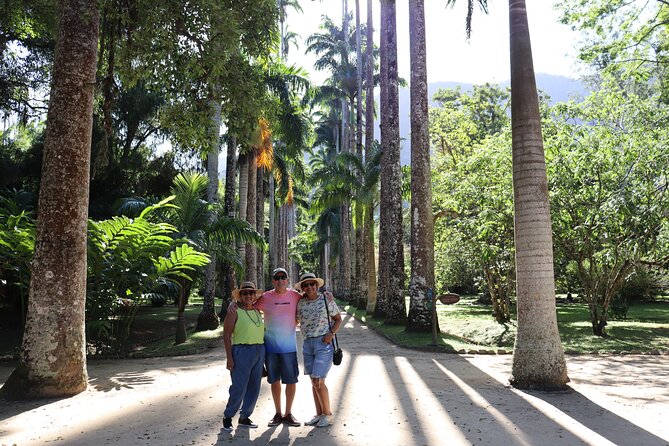
Rio de Janeiro has a way of surprising you. One minute you’re thinking about traffic and neighborhoods, and the next you’re walking in Atlantic Forest under a canopy that feels far from the city.
This tour is built around a simple idea: mix panoramic lookouts with a couple of “stay longer” forest stops. That’s why it works well for visitors who want nature and history, but don’t want to spend a full day hiking.
You can also read our reviews of more tours and experiences in Rio de Janeiro.



Vista Chinesa: the easy-start climb to a big payoff view

Vista Chinesa is an early twentieth-century monument tied to the story of Chinese presence in Brazil, including imported tea cultivation. The lookout area gives you wide panorama over the green parts of Rio’s southern zone, so it’s a strong first impression.
Here’s the practical part: the trail has easy access and is fully paved. You still face a demanding, steep climb to reach the peak, but at least you’re not dealing with rough trail conditions. For me, that’s a nice balance: clear footing, but you get a view that feels earned.
What to expect: viewpoint time (about 30 minutes) plus the payoff of a skyline-wide perspective if visibility is good. If the air is hazy, keep expectations flexible.
Emperor’s Table: Chinese labor stories tied to a royal resting spot
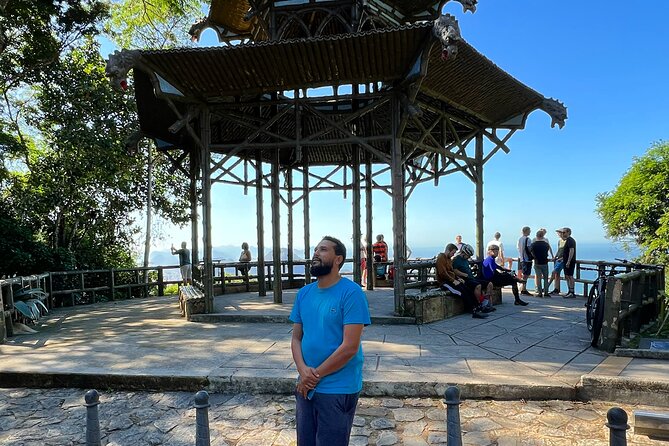
From Vista Chinesa, the tour moves to Emperor’s Table, a pavilion tied to the Royal Family’s frequent walks in the area. It’s also where the Chinese story becomes very specific.
This spot connects to the old plan to link the Botanic Garden to Alto de Boa Vista by a cantilevered road. Influence is credited to the Baron of Bom Retiro, with execution and maintenance contracted to Thomas Cochrane. The chronicle includes workers called “cules,” brought from China (Macau) to develop rice cropping. When the crop didn’t work as hoped, those workers were used to build the road.
There’s more: the area reflects an early wave of Chinese presence tied to the tea planters connected to D. João VI. After the tea crop failed, Chinese people were described as spreading through the Tijuca landscape. A map from 1844 records a building called Casa dos Chinas, likely a remnant of those earliest efforts. The pavilion itself was built later in 1903 under Mayor Pereira Passos, with a design by architect Luis Rey that copies bamboo using mortar—and it’s still visitable.
Why this matters for you: it turns a lookout stop into a “meaning” stop. You’re not just looking at trees; you’re understanding why these viewpoints exist and how cultures shaped Rio’s landscape.
Timing: plan for about 30 minutes here—enough to absorb the explanation and still enjoy the setting without feeling rushed.
Cascatinha Taunay: waterfall beauty plus a Roman-arch bridge
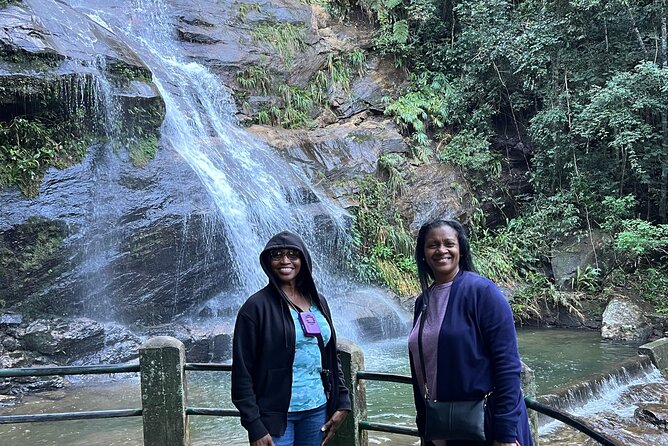
Cascatinha Taunay is the tour’s main waterfall moment, and it’s presented with strong historical context. The setting is in the Tijuca National Park area, where the highest PNT waterfall forms from waters of the Tijuca River, Conde River, and other tributaries.
One detail I really appreciate is that you’re not just walking to water—you’re looking at infrastructure history too. In 1860, engineer Job de Alcântara was commissioned by the Imperial Government to build a stone bridge in a Roman-arch format. That bridge stands in front of the cascatinha area, which makes the landscape feel both natural and engineered.
The arts and court story adds another layer. In 1817, artist Nicolas Antoine Taunay built a small house nearby, and he painted the waterfall. He hosted gatherings tied to the court, so this wasn’t only nature scenery—it was social scenery.
The house was later demolished in 1946, and the old Cascatinha restaurant was built on the site. That restaurant area is described as being prepared and refurbished to hold a café and a new restaurant.
What I think you’ll like: the mix of water, stonework, and story. It’s the kind of stop where a good guide makes the place feel alive, not just scenic.
Wildlife tip that fits this stop: one of the standout wildlife moments shared in the tour feedback is seeing monkeys swinging through the trees, along with the possibility of spotting toucans. You can’t count on animals on a schedule, but this forest route gives you a real shot.
Timing: about 1 hour at this stop—enough time to take photos, walk around, and settle into the atmosphere.
Parque Lage: Atlantic Forest walks near Jardim Botânico
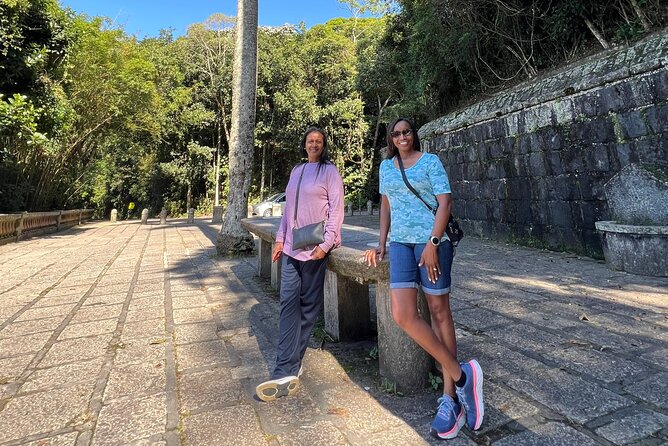
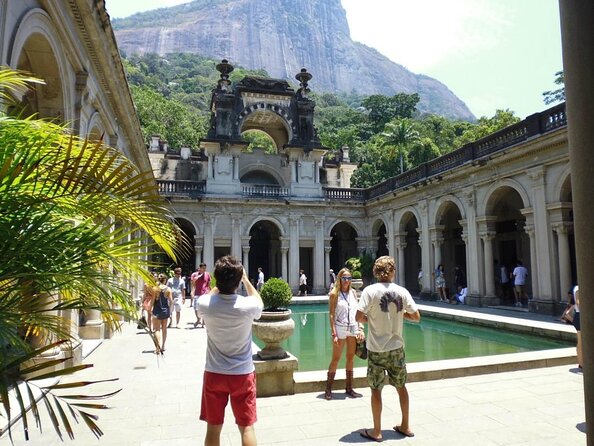
Parque Lage sits in the Jardim Botânico neighborhood in south Rio, inside the Tijuca National Park. It covers 52 hectares of forest, surrounded by the Atlantic Forest, so it’s not a trimmed-down park feel—it’s serious green space.
What makes this stop feel “worth the trip” is location. You’re close to major city anchors like Jardim Botânico and Cristo Redentor, but once you’re inside Parque Lage you can focus on the forest experience itself.
This stop runs about 50 minutes. In that time you’ll get a guided walk through the area and time in the park’s setting. In tour feedback, this is also where people appreciated the atmosphere around the park’s old mansion area, including the chance to have a drink there if you want one.
Practical note: expect a forest pace here rather than a fast photo sprint. If you love quiet, this is your reset.


How the 4-hour route stays manageable
The tour runs about 4 hours total, with the main stops timed roughly like this: 30 minutes for Vista Chinesa, 30 minutes for Emperor’s Table, about 1 hour for Cascatinha Taunay, and about 50 minutes for Parque Lage.
That mix matters. It includes:
- one viewpoint climb (Vista Chinesa),
- one history pavilion stop (Emperor’s Table),
- one waterfall setting with more walking time (Cascatinha Taunay),
- one forest walk zone where you’re not constantly changing locations (Parque Lage).
Also, the group cap is 14 travelers, which keeps it from feeling like a cattle line. The experience includes a guide, and transport can be handled by car or jeep depending on group size (with a note that transport for up to five people is available for convenience).
If you’re the type who gets cranky when tours feel rushed, this schedule is built to slow down at the best spots.
Price and value: what $88.21 buys in Rio
At $88.21 per person for about four hours, this isn’t a budget-only pick, but it also doesn’t read like a “pay for nothing” tour. Here’s the value breakdown:
- Guide included. The stops here are meaningful only when someone can connect the history to what you’re seeing—especially at Emperor’s Table and Cascatinha Taunay.
- Transport included. The forest and viewpoints sit in a region where getting between stops efficiently matters. You’re not left figuring out rides alone.
- Admissions are listed as free at all the stops described (Vista Chinesa, Emperor’s Table, Cascatinha Taunay, and Parque Lage).
What’s not included is equally important for value. Snacks and bottled water aren’t included. In practical terms, that means you should plan to buy something simple once you’re out there, or bring what you need if that’s allowed by your operator and your preferences.
If you’re comparing costs, don’t just look at the price tag. Look at the fact that this route compresses four specific experiences—viewpoint, history pavilion, waterfall zone, and forest park—into a single guided run with free-entry stops.
The small details that make a guide matter
Names show up in the tour feedback, and they point to the kind of service you can expect when the guide knows the story. Ederson is referenced in multiple positive experiences, and Jael appears in feedback describing a friendly, knowledgeable walk.
Even if you don’t care about names, you should care about the skill set:
- connecting Chinese tea and labor history to the lookout architecture,
- explaining why the bridge and waterfall sit together,
- guiding you through Parque Lage so the forest walk feels intentional.
A good guide also helps you pace yourself on the steep bits—especially at Vista Chinesa.
Weather and comfort: your best decision isn’t about the tour
This experience explicitly requires good weather. That’s not a minor note. In Rio’s forests, fog and rain can cut visibility and turn footing less fun, especially near the steep lookout climb.
So here’s my realistic advice:
- If the forecast looks rough, don’t force it. Wait for the clearer window the operator offers.
- Wear shoes with grip. Even though Vista Chinesa’s trail is paved, the climb is steep and you’ll want stable footing.
- Plan for time outdoors. This is a half-day where you’re outside for most of it.
Should you book this Tijuca-and-waterfall tour?
Book this if you want a half-day that balances real nature with place-based history. It’s a smart choice for first-time Rio visitors who want more than one “photo stop,” and it’s ideal if you like your tours guided—especially for Emperor’s Table and Cascatinha Taunay.
Skip it or think hard if steep climbs and changing weather would stress you out. If you’re very sensitive to hills, or if your trip dates have unstable weather, you may prefer a more flexible plan.
If you do book, treat it like what it is: a guided walk through Tijuca’s best contrasts—paved climbs and forest shade, skyline views and waterfall stonework—done at a pace that doesn’t waste your time.
FAQ
How long is the tour?
The tour is about 4 hours.
How much does it cost per person?
The price is $88.21 per person.
What’s included in the tour price?
The tour includes a guide and car or jeep transport (car/jeep type depends on group size). Admission tickets at the listed stops are free.
Is the group size limited?
Yes. The tour has a maximum of 14 travelers.
Which stops are part of the experience?
The tour includes Vista Chinesa, Emperor’s Table, Cascatinha Taunay, and Parque Lage.
Are any admission tickets required for the stops?
The stop descriptions list admission tickets as free for Vista Chinesa, Emperor’s Table, Cascatinha Taunay, and Parque Lage.
Are snacks or bottled water provided?
No. Snacks and bottled water are not included.
What happens if the weather is bad?
This experience requires good weather. If it’s canceled due to poor weather, you’ll be offered a different date or a full refund.
What is the cancellation policy?
You can cancel up to 24 hours in advance for a full refund. If you cancel less than 24 hours before, the amount you paid won’t be refunded.